Updated: November 2026. Two numbers decide whether a delivery makes money or costs money: the delivery fee and the minimum order value. In many restaurants they were set at some point, often copied from the competition, and have not been touched since. We have set up delivery areas for many restaurants, first with GloriaFood, today with eatbase. Along the way we found an order of steps that works: first work out the cost of a delivery, then set the delivery fee, then derive the minimum order value from it.
We go through these steps one by one here. You can recalculate all the numbers with your own values in the delivery fee calculator.
Step 1: What does a delivery cost you?
A delivery mainly costs two things: the driver’s working time and vehicle costs. The calculation is simple:
- Time = the way there and back at your average speed, plus a few minutes for handover, parking and waiting.
- Driver costs = time multiplied by the hourly wage including extra costs.
- Vehicle costs = kilometres driven (there and back) multiplied by the cost per kilometre.
We use these assumptions throughout the article: 17 € hourly wage including extra costs, a car at 0,30 € per kilometre, 25 km/h average speed in town, 5 minutes for the handover. The statutory minimum wage in 2026 is 13,90 € per hour, plus employer contributions, holidays and time off sick.
| Distance (one way) | Time per delivery | Cost per delivery |
|---|---|---|
| 1 km | 10 minutes | 3,38 € |
| 2 km | 15 minutes | 5,34 € |
| 3 km | 19 minutes | 7,30 € |
| 4 km | 24 minutes | 9,26 € |
| 6 km | 34 minutes | 13,18 € |
| 8 km | 43 minutes | 17,10 € |
Two things stand out. First, costs rise almost evenly with distance, and in this example each extra kilometre costs just under 2 €. Second, even a short delivery is not cheap, because the handover and the way back are always part of it.
If your driver takes several orders in one trip, the cost per order goes down. The table assumes one order per trip, so it is an upper limit. How to bundle trips and what that saves is calculated in Planning delivery routes.
Step 2: Stagger the delivery fee by distance
The delivery fee does not have to pay for the whole delivery. It should cover the part that grows with distance. The fixed rest is carried by the order itself.
A single delivery fee for the whole delivery area has a catch: it is too high for guests nearby and too low for guests at the edge. Two or three zones, where the fee rises with distance, are better. Lieferando describes it the same way in its customer service pages: restaurants set their own delivery prices, usually by delivery distance, time of day and day of the week.
A good starting point: a small fee in the nearby zone that hardly puts anyone off, and a noticeable surcharge for each further zone that roughly covers the extra driving costs.
Step 3: Derive the minimum order value
The minimum order value protects you from orders where the delivery costs more than the order brings in. The question behind it is: what percentage of the order value may the delivery cost at most, after the delivery fee is deducted?
The calculator assumes 30 % for this. That is a deliberately chosen benchmark: on its merchant page for Germany, Uber Eats states 30 % commission when Uber drivers deliver. Your own delivery should not cost you more than a platform charges for delivery and referral together. If you want to be stricter, use 25 or 20 %.
The formula:
Minimum order value = (cost per delivery − delivery fee) ÷ target share
An example for 3 km: the delivery costs 7,30 €, the delivery fee is 2,00 €. That leaves 5,30 €. Divided by 30 %, this gives 17,67 €, rounded up to 18 €. So with an order of 18 €, the delivery costs you at most 30 % of the order value, and less with every larger order.
Example: three delivery areas for a pizzeria
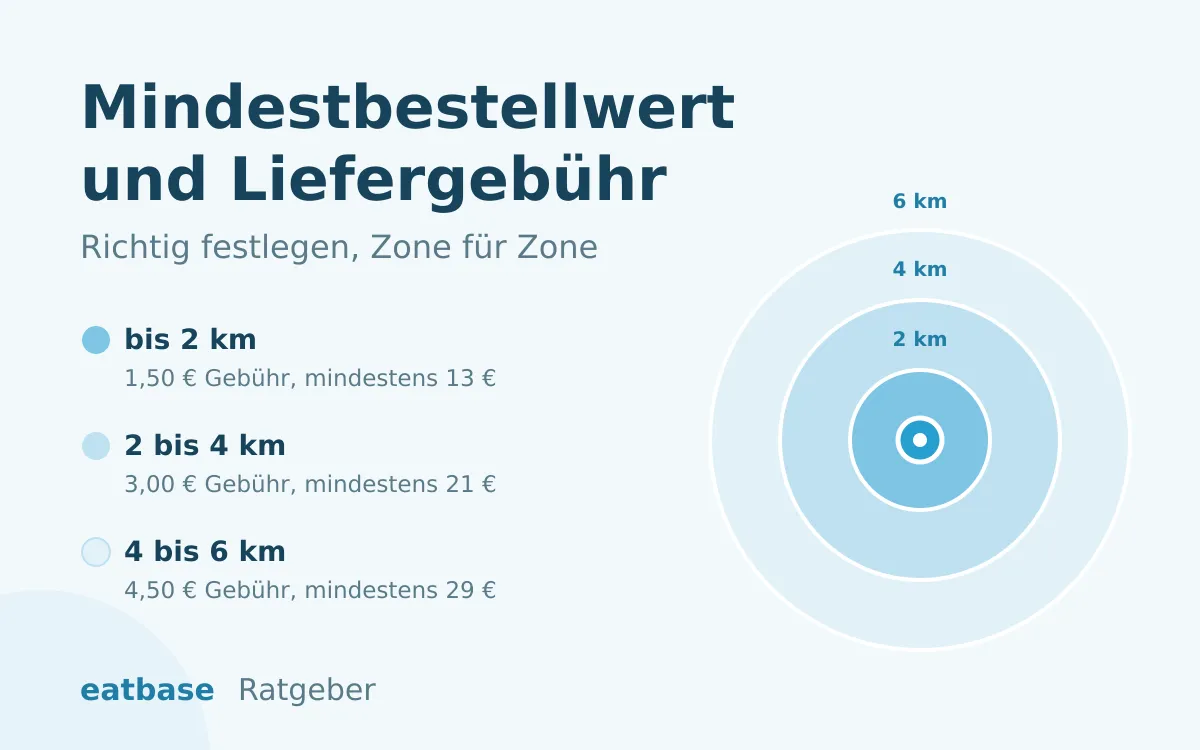
This is what it looks like for a pizzeria that delivers up to 6 km. Each calculation uses the outer limit of the zone, so the most expensive case:
| Delivery area | Delivery fee | Minimum order value |
|---|---|---|
| up to 2 km | 1,50 € | 13 € |
| 2 to 4 km | 3,00 € | 21 € |
| 4 to 6 km | 4,50 € | 29 € |
The calculation for the outer zone: 13,18 € cost minus 4,50 € fee gives 8,68 €, divided by 30 % that is 28,93 €, rounded up to 29 €.
If 29 € seems too high for the outer zone, you have three levers: raise the delivery fee there, make the zone smaller or bundle orders from that area. What doesn’t work is simply lowering the minimum order value and hoping it evens out through volume. Every delivery to that zone will then cost you more than you planned.
Work out your own zones
Enter vehicle, distance, hourly wage and delivery fee, and the calculator suggests a minimum order value for each distance. Free, no sign-up, and your numbers stay in your browser.
Free delivery from a certain order value
A popular option is “Free delivery from …”. You can set the amount with the same calculation: without a delivery fee, the order has to carry the whole delivery.
At 3 km and 7,30 € cost, a 30 % target share gives an order value of 24,33 €. So from around 25 € you can deliver for free at this distance without the delivery costing more than 30 % of the order value. In the nearby zone up to 2 km it would be around 18 €.
The advantage: some guests add something to the basket to reach the threshold. The disadvantage: on orders just above the threshold, you earn nothing from the delivery. So set the threshold a bit higher rather than too tight.
What we see again and again during setup
When setting up delivery areas, we keep coming across the same points:
- One price for the whole town. Guests on the outskirts are then paid for by those nearby, or delivering to the edge loses money.
- Values copied from the platform. When a platform’s own drivers deliver, the platform sets the delivery fee and minimum order value based on its own calculation. These values often don’t fit your own drivers.
- Not adjusted for years. Wages and vehicle costs go up. The minimum wage rises to 14,60 € on 1 January 2027. If your wage costs rise by the same proportion, a 3 km delivery in our example costs almost 30 cents more. Recalculating once a year is enough.
- Zones too large at the weekend. On Friday evening the drivers are fully busy, and every long trip takes the place of two short ones. Some restaurants make their delivery area smaller at peak times.
If you are also on delivery platforms
If you are also on a platform, check your contract before every change. Lieferando’s partner terms (as of 1 November 2024), for example, include an equal price guarantee that explicitly covers delivery fees and minimum order values too: what you charge on your own online channels should also apply on Lieferando. If the platform delivers with its own drivers, it sets the delivery fee and can set its own minimum order value. What the platforms cost is covered in separate articles: Lieferando fees and Wolt and Uber Eats.
Guests must see it beforehand
The delivery fee and minimum order value must be clearly shown on your ordering page before the guest orders. For orders online, the Price Indication Ordinance (Preisangabenverordnung) requires you to state whether delivery or shipping costs apply and how much they are. Ideally, the ordering page checks the guest’s address in the basket and shows straight away which fee and which minimum order value apply to them. That saves both sides trouble and phone calls. If in doubt, have your ordering page checked by a lawyer.
Frequently asked questions
How high should the minimum order value be? High enough that, after deducting the delivery fee, the delivery only costs a reasonable share of the order value. With 30 % as the limit and our example values, that is 13 € in the nearby zone up to 2 km (with a 1,50 € delivery fee) and 18 € at 3 km distance (with a 2 € delivery fee).
What is a fair delivery fee? One that rises with distance. Nearby, a small fee is often enough, and further away it should roughly cover the extra driving costs. In our example, each extra kilometre costs just under 2 €.
Delivery fee or higher minimum order value, which is better? Both work together. A higher fee allows a lower minimum order value and the other way round. For single guests, a low minimum order value with a small fee is often more pleasant, for families free delivery from a higher amount.
Do I have to calculate with the minimum wage if my driver is on a mini-job? Yes, the minimum wage also applies to mini-jobs (Minijob). The extra costs for a mini-job are different from those for a permanent employee. Enter your actual hourly rate including contributions in the calculator.
How often should I check the values? Once a year and whenever wages, vehicle or delivery area change. The minimum wage goes up on 1 January 2027, which is a good occasion.
Conclusion
First work out the cost of a delivery, then stagger the delivery fee by distance, then derive the minimum order value. With our example values, a 3 km delivery costs around 7,30 €, and each extra kilometre just under 2 €. Two or three zones, each with its own fee and minimum order value, are fairer for your guests and safer for your till than one price for everything.
At eatbase you create your delivery areas as an area on the map or as a radius, each with its own delivery fee and minimum order value. The guest enters their address in the basket and sees straight away what applies to them. More on the ordering system page.
Note: The calculations use simplified average values and are not a substitute for business, tax or legal advice. Information about delivery platforms is based on the providers’ public information, retrieved on 20 October 2026. Only the information and contracts of each provider are binding.