Updated: October 2026. When people search Google Maps for “pizza near me” in the evening, they often decide by the stars and the number of reviews. And Google itself says in its Business Profile help that more reviews and positive ratings can improve your local ranking. So for restaurants, reviews are not a side issue.
At the same time, hardly any area is so full of bad advice. A free dessert for five stars, review packages from agencies, only asking happy guests: all of this is either against Google’s policies, against competition law, or both. Here is what is allowed, what is not, and how to get noticeably more reviews the honest way.
What Google explicitly allows
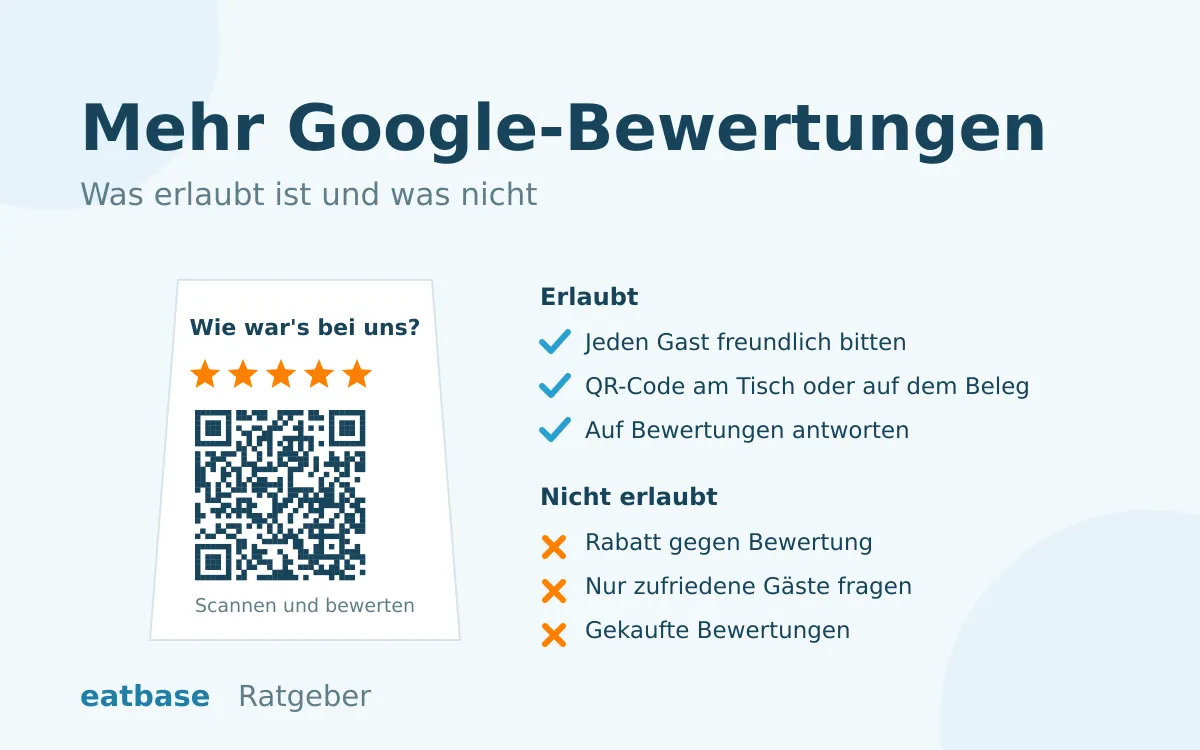
You may ask your guests for a review. Google even recommends it and suggests in its Business Profile help that you give guests a link or QR code for it. You will find the link in your Business Profile under “Get more reviews”.
So this is allowed: asking politely, making the path as short as possible and giving every guest the same opportunity.
What is not allowed
Google’s review policies are clear on these points. The following is not allowed:
- Incentives for reviews. Google explicitly names payments, discounts, free products and services. This applies even if you give the reward for every review, whether good or bad.
- Only asking happy guests. You may not specifically ask for positive reviews or prevent negative ones. A pre-check like “Did you enjoy it?”, after which only satisfied guests get the Google link, is exactly that.
- Pressure on site. Guests must not be pushed or obliged to leave a review in the restaurant. You also may not tell them what to write.
- Targets for staff. Employees must not be told to collect a certain number of reviews.
- Reviews from people close to you. Anyone who works or has worked for you, or who is family, has a conflict of interest. Google removes such reviews.
- Bought and fake reviews. Whether from an agency or from friends on request: they break the policies and are removed.
| What | Allowed? |
|---|---|
| Asking every guest politely for a review | yes |
| QR code on the table, at the till or on the receipt | yes |
| Replying calmly and factually to every review | yes |
| Reporting reviews that break the policies | yes |
| Only asking happy guests | no |
| Pushing guests at the table to leave a review | no |
| Discount, drink or voucher in exchange for a review | no |
| Buying reviews or having your team write them | no |
What competition law says
Besides Google’s rules, there is the German Act Against Unfair Competition (Gesetz gegen den unlauteren Wettbewerb, UWG). Since May 2022, its annex, known as the black list, says under no. 23c: submitting or commissioning fake consumer reviews is always prohibited. Anyone who buys fake reviews can receive a formal warning letter (Abmahnung) from competitors and associations.
Rewarding genuine reviews is also tricky. In 2010 the Hamm Higher Regional Court (Oberlandesgericht Hamm) ruled that a discount for a review is anti-competitive if the review does not show that the customer received something for it (case no. I-4 U 136/10, confirmed in 2013 with case no. 4 U 48/13). On Google you cannot disclose this at all, and rewards are banned there anyway.
If you show reviews on your own website, § 5b (3) UWG also requires you to state whether and how you make sure they come from real guests.
How to get more reviews honestly
Happy guests often don’t leave a review simply because nobody asks and the way there is too long. That is exactly where you start.
Choose the right moment. Good moments are the bill, the handover at the pickup counter and the delivery. The visit is still fresh, and the guest has their phone in hand anyway.
Make the way short. A QR code that opens the review window directly saves guests from searching for your listing. Good places for it are a table stand, the till, the receipt or a small note in the delivery bag.
Ask everyone the same way. A sentence like “If you enjoyed your meal, we would be happy to get a review on Google” on a table stand is fine. It is aimed at everyone and leaves the choice to the guest. A stand saying “5 stars only!”, on the other hand, tells guests what to write.
Involve your team, without quotas. Waiting staff may point out the QR code. A bonus per review collected or a target number per shift, however, is not allowed under Google’s policies.
Be careful with emails. Legally, asking for a review by email counts as advertising. The Federal Court of Justice (Bundesgerichtshof) ruled this in 2018 for a satisfaction survey in an invoice email (case no. VI ZR 225/17). Only send such emails to guests who have agreed to receive them.
You can build a ready-made table stand with our free QR code generator for Google reviews. It finds your restaurant’s review link automatically, and you print the result as a table stand or poster. The code leads directly to your Google listing, without going through our server.
Replying to reviews
Replies are public. So you are not just writing to that one guest, but to everyone who reads your reviews. In its Business Profile help, Google recommends friendly, short and timely replies, with no advertising and no offers.
For positive reviews, a short, personal sentence is enough. For negative reviews, this structure helps:
- Say thank you and take it seriously. Even if it is hard.
- Admit your own mistakes. If the pizza really took 70 minutes, say so.
- No private data. Order number, address or reservation time do not belong in the reply.
- Offer a way to talk. For example an email address or phone number.
- Sign with your name. That feels more personal than “Your team”.
An example:
Thank you for your honest feedback. On Friday evening we were short-staffed in the kitchen, and the delivery took far too long. We are sorry about that. If you like, write to us at hallo@ihr-restaurant.de and we will sort it out directly. Best regards, Giulia
And what if a review clearly doesn’t come from a guest? Then you can report it through your Google Business Profile. In 2022 the Federal Court of Justice ruled for a hotel review portal that simply objecting that there was no guest contact basically obliges the portal to check (case no. VI ZR 1244/20). Whether and how quickly Google removes a reported review, however, is up to Google.
How we handle this at eatbase
On the eatbase Pro plan, guests see a button for a Google review on the status page after their online order, as soon as the order is on its way, ready for pickup or completed. Guests who have agreed can also get a short email reminder if you want. Everyone gets the same link, with no satisfaction pre-check and no reward. The details are on the ordering system page and on the pricing page.
Independently of this, you can get the QR code for tables and counter for free with the review tool.
Frequently asked questions
Can I give a discount if I don’t care whether the review is good or bad? No. Google bans incentives for reviews in general, not just for positive ones. A free espresso in exchange for a review counts too.
Can I have negative reviews deleted? You cannot delete them yourself. If a review breaks Google’s policies, for example because it is insulting or does not come from a guest, you can report it. A review you simply don’t like will stay.
Can my employees review us? No. Google sees this as a conflict of interest and removes such reviews. This also applies to former employees and family.
Can I ask guests to mention a specific dish? No. Under Google’s policies you may not tell guests what to write in the review. Ask openly for a review and leave the content to the guest.
Can I show my Google reviews on my website? Yes. But under § 5b (3) UWG you then have to state whether and how you make sure the reviews come from real guests. If you don’t check anything yourself, say so openly, for example with a note that the reviews are taken from Google. If in doubt, have the exact wording checked by a lawyer.
Conclusion
You don’t get more Google reviews with tricks, but with a simple request to all guests at the right moment and a QR code that makes the way short. Rewards, pre-checks and bought reviews can, in the worst case, cost you a formal warning letter or your reviews. And if you reply calmly to every review, you show new guests that feedback matters to you.
This article reflects the situation as of October 2026 and is not legal advice. Google is a trademark of Google LLC, eatbase is not affiliated with Google.