Updated: October 2026. Tips used to be simple: the guest leaves some change, the waitress pockets it. Today many guests pay by card or online, and the tip first lands in the business’s account. That raises questions that hardly existed before. Who does the money belong to? Does it stay tax-free? And can the kitchen get a share?
Because tips now also go through ordering systems like ours, we took a close look at the topic. Here is what is legally certain, where things are unclear and how to put a fair split properly in writing.
Who do tips belong to?
The German Trade Regulation Act (Gewerbeordnung, GewO) defines a tip in § 107 (3) as an amount of money that a third party pays to the employee voluntarily, on top of a service owed to the employer. So the guest gives it to your employees, not to your business.
Three things follow from this:
- You may not take a share. The tips go in full to the employees they are meant for.
- Tips don’t replace wages. Under § 107 (3) GewO, regular pay may not be excluded by pointing to tips. Tips do not count towards the minimum wage.
- You can’t simply order how tips are split. The Rhineland-Palatinate Regional Labour Court (Landesarbeitsgericht Rheinland-Pfalz) ruled that the employer’s right to give instructions is not enough to impose collecting and splitting tips on its own (case no. 10 Sa 483/10). A shared tip pot therefore needs the team’s agreement, ideally in writing or in the employment contract.
When tips are tax-free
Under § 3 no. 51 of the German Income Tax Act (Einkommensteuergesetz, EStG), tips are tax-free for employees, with no upper limit. The conditions: they come from a third party, meaning the guest, they are voluntary, there is no entitlement to them, and they are paid on top of the bill amount. Tax-free tips are also free of social security contributions and do not count towards the earnings limit for mini-jobs.
| Case | Tax-free? |
|---|---|
| Cash tip from the guest to the server | yes |
| Card tip, passed on in full | usually yes |
| Fixed service charge on the bill | no |
| Tip to the owner personally | no |
| Pot, split by the business | not clear |
With card tips you only hold the money in trust, more on that below. A fixed service charge, on the other hand, is not a tip, because the guest has to pay it. And with a shared pot the situation is not clear, more on that below too.
One point many owners are not aware of: if you serve guests yourself and get tips, they are not tax-free for you. They are part of your business income, and the Saxony Finance Court (Sächsisches Finanzgericht) ruled that for the landlord of an owner-run restaurant they are also subject to VAT (case no. 4 K 1932/10).
Card tips: the money goes through your account
If the guest pays 50 € on a bill of 46 €, 4 € in tips arrive in your account. That means you are holding money that belongs to your staff. For tax purposes this is not a problem as long as you only manage it: in 2015 the Federal Fiscal Court ruled that tips stay tax-free if the employer keeps them as a kind of trustee and splits them according to fixed rules (case no. VI R 37/14).
How to do it properly:
- Record tips separately. In the till, they don’t belong in sales but in a separate line.
- Pay out in full and promptly. For example weekly, in cash against a signature or by bank transfer.
- Coordinate with your payroll office. If you pay tips out through payroll, they must be listed there as tax-free tips and not as wages.
- Write everything down. More on that below.
The same applies to tips that guests give with an online order. These also reach you first and then belong to the person or team they are meant for, for example the driver.
The shared pot: where it gets unclear
Many businesses collect all tips in one pot and split them at the end of the week. That is fair and avoids arguments. For tax purposes, however, the situation is not clear:
- In 2015 the Federal Fiscal Court decided a case in which the employer collected tips and split them using a points system. Result: tax-free, because the employer only acted as a trustee (VI R 37/14).
- For the tronc at casinos, on the other hand, the BFH ruled that payments from it are not tax-free tips. The money went into the tronc anonymously, and the casino itself split it (VI R 49/06).
- In its guide for restaurants (as of February 2026), the Minijob-Zentrale (the central office for mini-jobs) writes that tips collected in a pot and split among all employees by the employer may be treated as taxable earnings. If in doubt, the tax office decides.
What this means in practice: the more the team decides itself and the less you decide as the employer, the closer you are to the BFH case. The team sets the split and signs it, and you only keep the money and pay it out, with no share for yourself. If a lot of money is involved, you can request a binding ruling (Anrufungsauskunft) under § 42e EStG from the tax office responsible for your business. Then you know for certain how the tax office treats your pot for wage tax purposes.
Can the kitchen get a share?
Under employment law, yes, if the team agrees. Many guests mean their tip for the whole restaurant anyway.
For tax purposes, the question is open. In older rulings the BFH required a certain personal relationship between the guest and the recipient. According to our research, no court has yet decided for the restaurant trade whether the kitchen, which never sees the guest, meets this condition. In practice, many businesses include the kitchen, often with a lower weighting than the service staff. Discuss this with your tax adviser before you make it a fixed rule.
A fair split in practice
Splitting by hours with a weighting per area has proven itself. Each person gets points: hours multiplied by weighting. The pot is divided by all the points, which gives the amount per point.
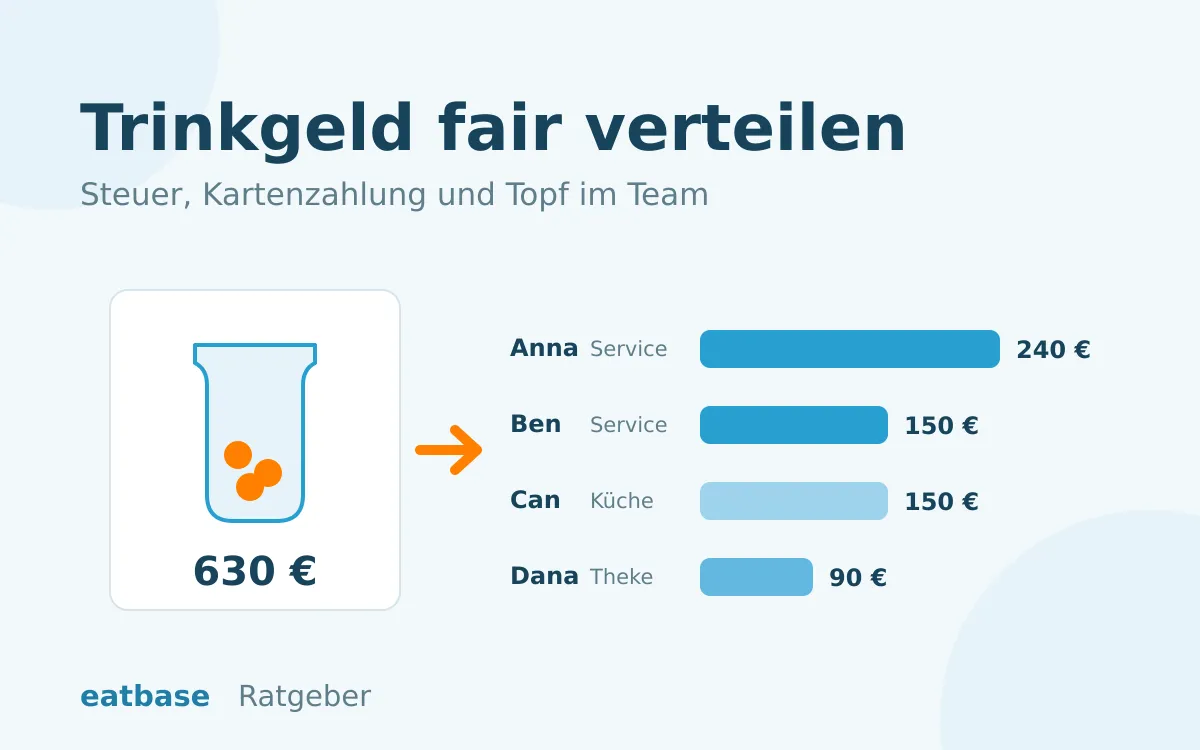
An example: in one week, 630 € comes together. Service counts in full, the bar at 0,75 and the kitchen at 0,5.
| Person (area) | Points | Share |
|---|---|---|
| Anna (service, 32 h x 1) | 32 | 240 € |
| Ben (service, 20 h x 1) | 20 | 150 € |
| Can (kitchen, 40 h x 0,5) | 20 | 150 € |
| Dana (bar, 16 h x 0,75) | 12 | 90 € |
| Total | 84 | 630 € |
630 € divided by 84 points gives 7,50 € per point. Which weightings you use is up to you. What matters is that everyone knows the split and it applies equally to all.
With the free tip calculator you enter the pot, hours and weightings and get the split along with a list to print. If you want, it rounds to whole euros or 50 cents and shows you the remainder to carry over to the next week.
Documentation: what you should write down
With card tips in particular, you should be able to show at any time that the money reached the team in full. A simple list per week is enough:
- Period and total amount, separated into cash and card
- the agreed split
- Hours, points and amount per person
- Signature or transfer receipt per person
Keep the lists together with your accounting records. The written agreement with the team about the pot belongs there too.
How we handle this at eatbase
In the eatbase ordering system, guests can already give a tip when ordering online, and you set the suggested amounts yourself. This is included in every plan. For businesses with their own drivers there is our driver app. There, the tips from each shift appear directly in the driver’s cash-up, together with cash, card and every single delivery. So you can see at a glance who is owed which tips.
Frequently asked questions
Is there an upper limit for tax-free tips? No. For employees, voluntary tips from guests are tax-free without limit under § 3 no. 51 EStG. This does not apply to you as the owner.
Do tips count towards the earnings limit for mini-jobbers? According to the Minijob-Zentrale, tips that guests give directly and voluntarily do not count as earnings. With tips from a pot split by the employer, this is less clear. If in doubt, ask your payroll office.
Can I deduct card fees from tips? Under § 107 (3) GewO, tips belong to your employees. A deduction for your costs is hard to reconcile with that. If you still want to do it, you need a clear agreement and should get advice on employment law.
Is a service charge a tip? No. A fixed surcharge on the bill is not voluntary. It is part of your sales, including for VAT, and if you pass it on to staff, it counts as normal wages.
Do I have to step in if the team argues? You can suggest a split, but you cannot impose it on your own. The best thing is to sit down together once, write the rule down and have everyone sign it. That saves every discussion later on.
Conclusion
Tips belong to the team. Cash is simple, but with card tips you are a trustee and should keep everything properly separated and written down. With a shared pot and including the kitchen, the tax question has not been fully settled. With a split the team sets itself, and a binding ruling from the tax office for larger amounts, you are on the safe side.
This article reflects the situation as of October 2026 and is not tax or legal advice. What is binding for your business is what you clarify with your tax adviser, your payroll office and your tax office.