Updated: October 2026. In nationwide checks of online menus, the food authorities found missing allergen information at almost half of the 1.273 businesses they inspected. Around 45 % had no information on additives. The figures were presented by the Federal Office of Consumer Protection and Food Safety (Bundesamt für Verbraucherschutz und Lebensmittelsicherheit, BVL) in November 2023. Notably, the businesses’ own websites had more violations than the delivery platforms.
This matches what we see when moving menus into an ordering system. The paper menu in the restaurant is often labelled correctly, but the PDF menu on the website or the order form is not. This article shows what is required where and how to get it right with little effort.
Which rules apply
The basis is the EU Food Information Regulation, LMIV for short (Lebensmittelinformationsverordnung, Regulation (EU) No 1169/2011). For everything you prepare fresh and hand over unpackaged, known as “loose goods” (lose Ware), allergen information is mandatory under Art. 44 LMIV. Other information such as nutritional values is not required for loose goods.
How you declare allergens is regulated in Germany by § 4 of the Food Information Implementing Regulation (Lebensmittelinformations-Durchführungsverordnung, LMIDV). For additives such as colourings or preservatives, the Food Additives Implementing Regulation (Lebensmittelzusatzstoff-Durchführungsverordnung, LMZDV) has applied since June 2021. It replaced the former Additives Approval Regulation (Zusatzstoff-Zulassungsverordnung). The obligations apply to anyone who serves food to guests: restaurant, snack bar, café, food truck, catering service and delivery service.
The 14 main allergens
Annex II of the LMIV lists 14 substances that most often cause allergies and intolerances. The list is complete. The letters in the table are common in Germany, but no specific assignment is required.
| Allergen (found for example in) | Code |
|---|---|
| Cereals containing gluten (pizza dough, pasta, breadcrumbs, beer) | A |
| Crustaceans (prawns, scampi) | B |
| Eggs (mayonnaise, fresh pasta, breadcrumbs) | C |
| Fish (Worcestershire sauce, Caesar dressing) | D |
| Peanuts (satay sauce, peanut oil) | E |
| Soy (soy sauce, tofu) | F |
| Milk (cheese, cream, butter, pesto) | G |
| Tree nuts (pesto, nougat, marzipan) | H |
| Celery (stock, spice mixes) | L |
| Mustard (dressings, remoulade) | M |
| Sesame (hummus, sesame rolls, sushi) | N |
| Sulphur dioxide and sulphites (wine, dried fruit, vinegar) | O |
| Lupin (lupin flour in baked goods) | P |
| Molluscs (mussels, squid) | R |
One point that is often overlooked: for cereals containing gluten and for tree nuts, the authorities expect the specific type. So not just “cereals containing gluten”, but “wheat” or “spelt”, and not just “tree nuts”, but “hazelnut” or “walnut”. The information sheet of the Dithmarschen district states explicitly that cereals and tree nuts must be declared “by their name”. The easiest way is to add the type in brackets after the letter, for example “A (wheat)”.
How you can label
§ 4 LMIDV gives you several options. In all of them, guests must be able to see the information before they order, and it must be easy to read.
- Right next to the dish. The allergens are listed on the menu with each dish.
- With letters and a key. Codes appear after the dish, with the explanation at the bottom of the menu. The LMIDV calls these footnotes or endnotes. They are allowed if the name of the dish clearly refers to them.
- On a sign or notice. Handy for the counter, daily specials on the board and buffets.
- In writing or electronically. For example an allergen folder or a tablet. In that case there must be a notice in the restaurant telling guests how to get the information.
- Verbally. This is possible, but only under certain conditions. More on that below.
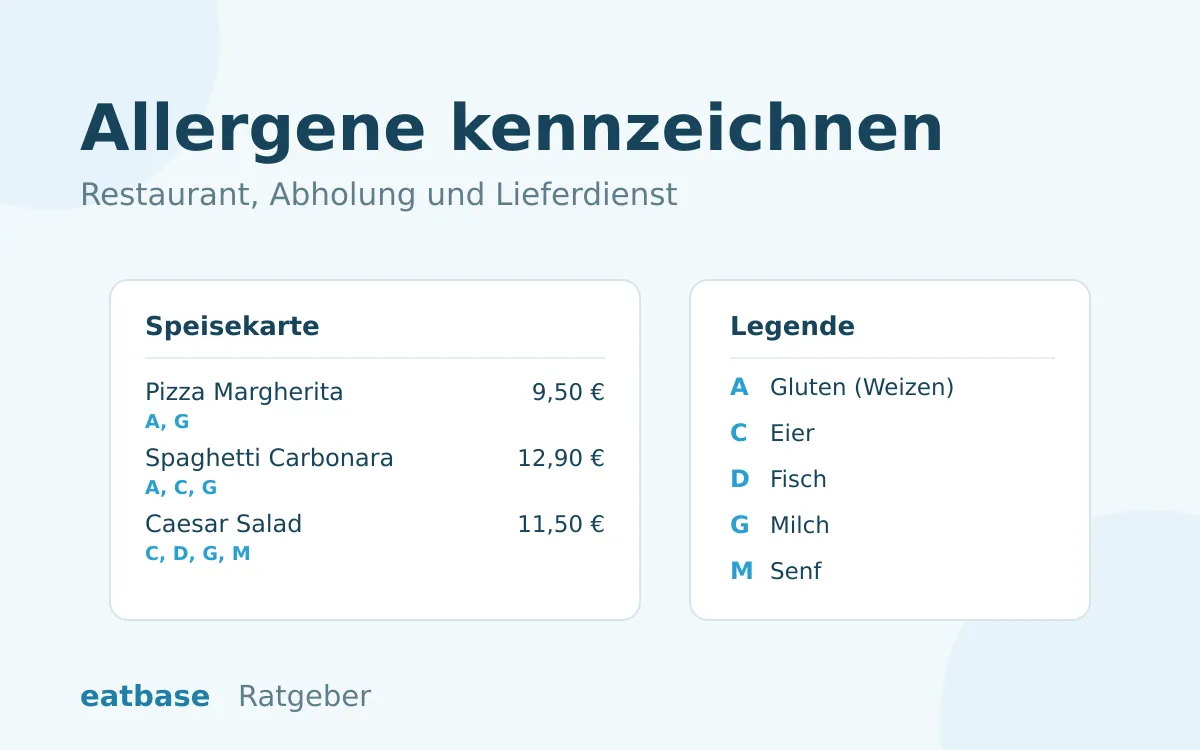
An example of the letter method:
Pizza Margherita A (wheat), G … 9,50 € Spaghetti Carbonara A (wheat), C, G … 12,90 € Caesar Salad C, D, G, M … 11,50 €
The key then appears at the bottom of the menu: A = cereals containing gluten, C = eggs, D = fish, G = milk, M = mustard.
Verbal or written: what works in practice
Many restaurants put up a note: “Please ask our staff about allergens.” That is allowed, but on its own it is not enough. Under § 4 (4) LMIDV, information may only be given verbally if three things come together:
- The information is given immediately on request, before the order. It may be given by the owner or by staff who are properly informed.
- There is a written or electronic record of the ingredients used. It must be available to the food inspectors and, on request, to guests as well. A table with all dishes and ticked allergens is enough.
- A clearly visible notice in the restaurant or next to the dish says that verbal information and the record are available.
In practice this means: you cannot do without the list. And if you keep the list anyway, you might as well put the letters on the menu. Then your Saturday night temp does not have to run to the kitchen to ask, and guests see everything at a glance.
Online orders and delivery
If you sell online, through an app or via a delivery platform, you are selling at a distance (Fernabsatz). Art. 14 LMIV applies here. For loose goods it refers to the same allergen information and sets two points in time:
- Before the order is completed, the information must be available. Either on the ordering page itself or through another suitable means that you clearly name. Guests must not have to pay anything extra for it.
- At the time of delivery, the information must also be available.
A note saying “Please call us to ask about allergens” is risky online. The Berlin Court of Appeal (Kammergericht Berlin) confirmed in a case against an online food retailer that referring to a hotline does not replace the mandatory information online (case no. 5 U 152/16). That case was about packaged goods, but Art. 14 LMIV applies the same points in time to loose food. The safest option is to show the allergens right next to the dish in the order form.
The regulation does not say exactly what the information must look like at delivery. What works well in practice is printing the allergen codes on the receipt or delivery note, or putting a card with the key in the bag.
If you also sell through platforms, check your listings there in the same way. Your business is responsible for correct information, not the platform.
Don’t forget additives
Besides allergens there are additives. Here the wording is fixed, but the numbering is not. Numbers with a key are common, for example:
- 1 = with colouring (for example cola)
- 2 = with preservative
- 4 = with flavour enhancer (some seasoning mixes and types of sausage)
- 11 = contains caffeine (cola, energy drinks)
- 12 = contains quinine (tonic water)
For the azo dyes E 102, E 104, E 110, E 122, E 124 and E 129, a warning must be added: “May have an adverse effect on activity and attention in children”. The additives are usually listed on the packaging of your ingredients, especially for drinks, sausage and ready-made sauces.
Common pitfalls
Most mistakes don’t happen with the pizza, but with things you don’t make yourself:
- Ready-made sauces and seasonings. Soy sauce usually contains wheat, Worcestershire sauce contains fish, stocks and spice mixes often contain celery, dressings contain mustard.
- Changing suppliers. The new pesto from the wholesaler may contain different nuts than the old one. Check the label every time you switch.
- Daily dishes and specials. The chalkboard needs allergen information too.
- Drinks. Wine usually contains sulphites, beer contains barley or wheat, coffee drinks contain milk.
- Translated menus. If you have an English menu, the allergens there must be just as correct.
A clean menu in five steps
- Write all dishes and drinks on a list.
- Go through every recipe and check the ingredient list or the supplier’s data sheet for every ingredient you buy.
- Tick the allergens and additives for each dish. For cereals and nuts, note the type.
- Copy the codes onto your menu, website and ordering page, with a key.
- Set a fixed date for checking the list, and check it straight away whenever a recipe or a supplier changes.
For steps 3 and 4 we built a free allergen helper. You enter your dishes, tap the allergens and get the labelling with a key to copy or print. The tool suggests what to think about based on keywords, but you tick the boxes yourself. Your dishes stay in your browser.
How we handle this at eatbase
The eatbase ordering system already includes the 14 main allergens and the common additives. You just tick what each dish contains, and the information appears on your ordering page right next to the dish. Guests who read your menu in English, Turkish or one of the other six languages see the allergens in fixed translations. More on the ordering system page.
But only your kitchen knows which allergens are in your dishes. No system can do that work for you.
Frequently asked questions
Do I have to declare allergens for drinks too? Yes. The obligation applies to all food you hand over loose, so drinks as well. Typical examples are sulphites in wine, barley or wheat in beer and milk in coffee drinks. Then there are additives such as “contains caffeine” for cola.
Are there required letters? No. The A to R assignment is common in Germany, but it is not mandatory. What matters is that the key is on the same menu and guests understand it.
Is the sentence “Please ask our staff” enough? Only together with a written overview of all dishes that guests and the authorities can access, and with staff who know the details. Without this list, verbal information is not sufficient.
Do I have to state “may contain traces”? The obligation covers ingredients that are actually used in the dish. The LMIV does not make notes on possible traces a mandatory item. If you give such notes, they should be correct and not just appear on every dish by default.
What applies to orders via Lieferando or Wolt? The same rules as on your own ordering page. The allergens must be visible before the order. So check regularly that your information there is complete and up to date.
Who checks this? The food inspection authority (Lebensmittelüberwachung) of your district or city. Many offices have published information sheets and sample menus and will also answer questions in advance.
Conclusion
Labelling allergens takes diligence, but it is not rocket science. A complete list, letters on the menu, the type of cereal and nut added, and everything visible online before the order. Then you can relax during an inspection, and guests with allergies can order from you with confidence.
This article reflects the legal situation as of October 2026 and is not legal advice. If you have questions about your business, your local food inspection authority can help.